Jagged Ends - A Guest Blog by Les Wallace
Adapted with permission from an article for Mark Avery's Blog 'Standing Up For Nature' Feb 25th 2021. Read the original article here, together with some interesting comments.
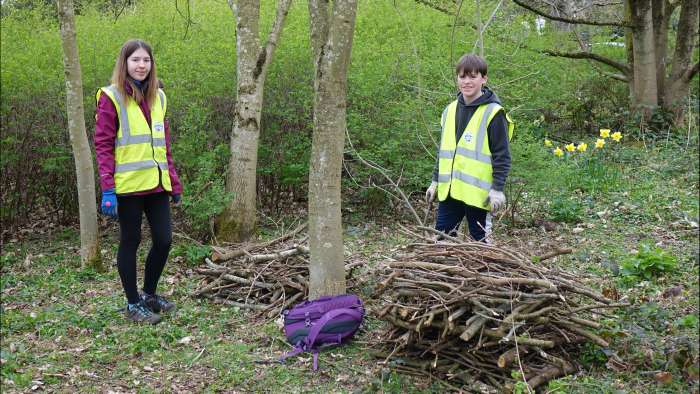
It’s surprising the amount of practical conservation work that involves cutting trees down and up rather than planting them – preventing encroachment on peat bogs and meadows, keeping paths clear, letting more light in for ground flora and of course clearing non native invasive shrubs and trees. The brash is the smaller twigs and branches that result from sawing them off from the main trunk to give workers room to move and enable handling of material.
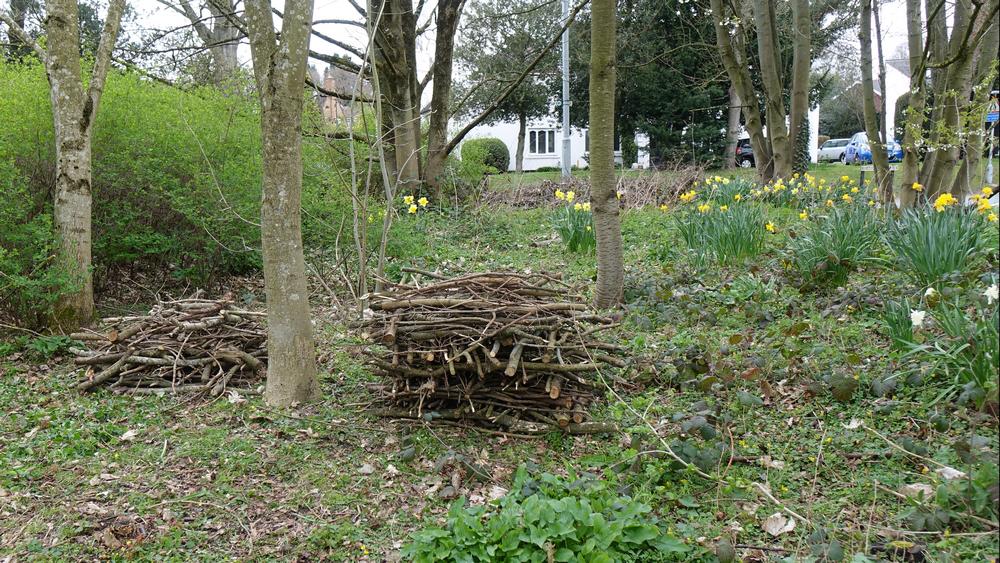
Brash is most definitely not rubbish, it still constitutes dead wood of which there is a terrible deficit in the vast majority of our woodlands. When stacked up in what are known as habitat piles (and sometimes ‘dead hedges’) it can spend literally decades providing hibernating space for amphibians and hedgehogs, nesting places for wrens, robins, dunnocks and even song thrushes. Countless invertebrates and fungi will move in and slowly rot woody material down helping to create biodiverse soils for the next generation of trees and generally recycling nutrients for all forest life. The practice of creating habitat piles is increasing, but very sadly even with many conservation projects brash is still burnt for the jolly old stereotypical campfire with the breaking out of the end of session biscuits and cups of tea (old bits of pallet or offcuts could have been brought in for this instead of course).
Occasionally there is a good reason for some burning especially when invasives are being cleared and there’s just far too much material to accommodate in piles – plus some species such as cherry and Portugese laurel can re-root from a cut branch left on damp ground. However, the vast majority of the brash you see going up in smoke in those pictures of grinning volunteers around a roaring bonfire didn’t have to become a wildlife unfriendly pile of ash – when, like me, you’ve seen birds desperate for nesting places fly in to inspect a habitat pile literally minutes after you’ve made it seeing it incinerated elsewhere makes your heart sink to your feet.
‘The best laid schemes o’ Mice an’ Men Gang aft agley,’….especially during a sodding pandemic. If it hadn’t been for Covid 19 by now the efforts of yours truly, a very kind film maker donating his time, volunteers and a couple of glove puppets the cinematic epic ‘Love Hedgehogs Don’t Burn Brash’ would have been unleashed upon the world rather than a nasty virus.
Our plan with the video was to emphasise why habitat piles are really important for wildlife by adding little touches to hopefully enhance their value for invertebrates, fungi, birds and hedgehogs – they would incorporate mini ‘log cabins’ for the latter no less. It would be especially good at explaining to children why habitat piles are great for wildlife and be considerably more interesting then just piling up brash, even though that’s still great.
Sadly until covid related restrictions are eased this notification of our intentions will have to suffice until the full fruit of them can be presented on the world stage. However, there’s one element of the ‘new’ habitat piles that can be highlighted here thanks to a rather wonderful accident I only wish I’d taken a better photo of as it’s such a beautiful illustration of it.
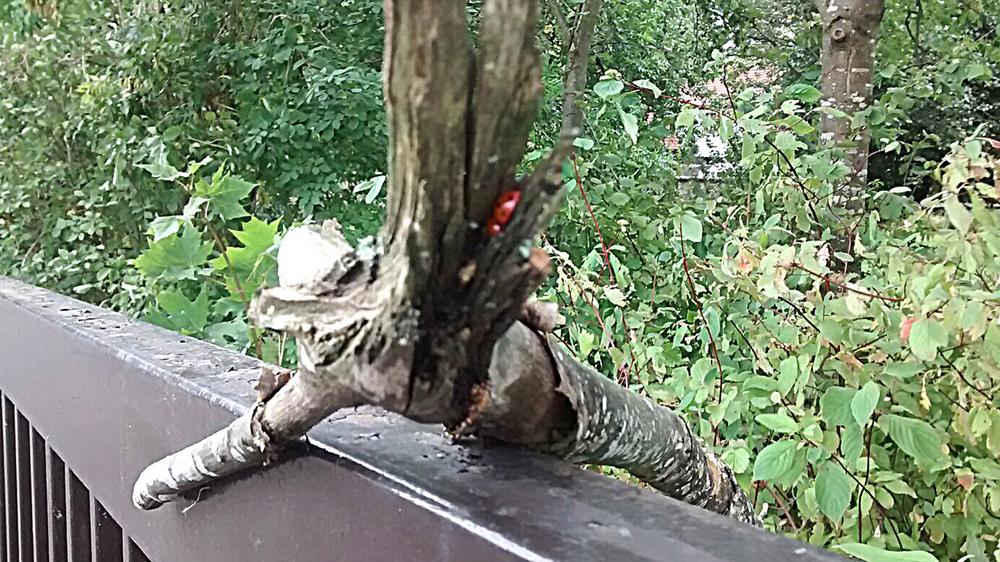
I was walking back home from a shopping trip and decided to turn off down a
slightly longer, but more scenic route. A couple of days beforehand we’d been hit
with some very high winds so no great surprise to see that a smallish branch
snapped off by them had been caught on top of a railing. As I walked past it out
of the very corner of my eye I caught a flash of deep red that was so out of place
I automatically stopped, swung round and looked more closely. Straight lines
and edges are virtually unknown in nature and as the branch had been snapped
by wind not cut by bow or pruning saw its end was broken, jaggy. It was down
into one of the many niches created by the splintered wood that two ladybirds
had crawled for shelter. They just would not have been able to do this with the
utterly flush cut ends seen on the branches that are often used in the log and
habitat piles that are supposed to help wildlife, it’s been very disheartening to
have seen such in the likes of Nature’s Home.
This little incident graphically illustrated why this isn’t merely a form of Victor Meldrew negativity and pedantry on my part, something I’d occasionally wondered about with a little guilt. Coloration meant to advertise distastefulness to would be predators had incidentally emphasised the value of recesses to the wildlife that one way or another uses the structure provided by dead wood.
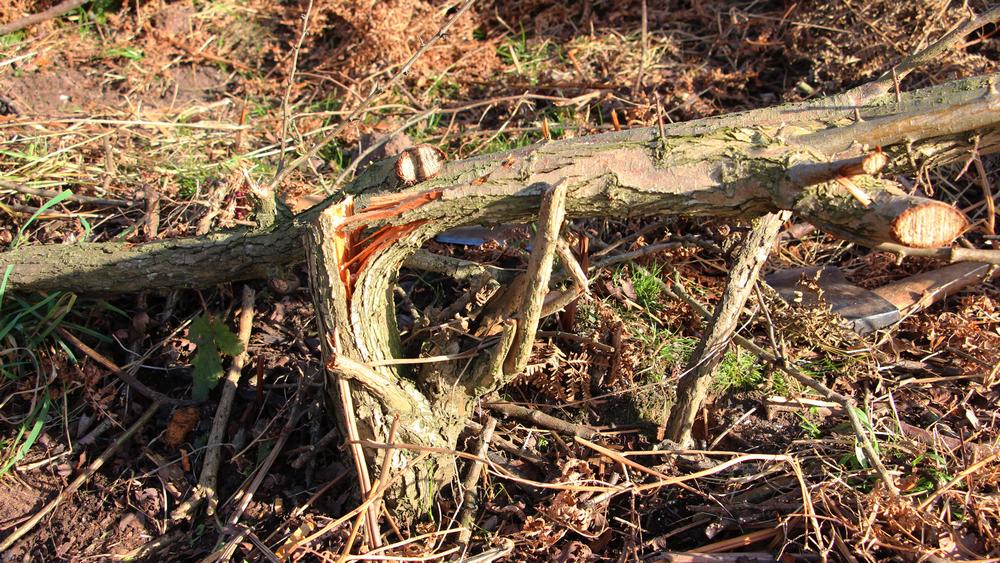
Bark helps protect the living tree from insect and fungal attack, so exposed wood is especially important in allowing the process of decay and deconstruction to begin as part of the natural recycling process. Jagged, natural ends win hands down, first of all they present a much larger surface area of exposed wood than an artificially cut one, and then of course it has gaps/niches for inverts to crawl into and fungal spores to get lodged in out of the drying sun and grasping wind.
The fact that a small broken branch stuck on top of a railing brought me such a burst of joy and renewed enthusiasm is I suggest indicative of the wonders of nature rather than personal inadequacy on the part of yours truly. Certainly life is far, far too short and precious not to fill up as many gaps in it as possible with something special to make you realise how wonderful it is. This is what I think nature is fantastic, insuperable for even with a third rate field naturalist like me.

How in hell did that woodpecker know the broken top of the dead tree is a fantastic place for drumming? That wee bird struggling on the ground can’t possibly be a little auk this is Callander Park, Falkirk halfway between Glasgow and Edinburgh…good god no it really is a little auk! There are ants going up and down the trunk of this coppiced sycamore they must be collecting honeydew from aphids. Where are the aphids most likely to be – on the fresh young leaves that are most tender and the most nutrient rich sap? Yeah, when I checked the youngest leaves first the undersides were dark with solid masses of aphids, there wasn’t a single one to be seen elsewhere. A tiny, tiny thing, but special to me as I felt like David Attenborough for a day which was brilliant for a shy, speccy kid entering his teens. There are dozens, hundreds more that mean nothing to anybody else, but everything to me.
Anyway enough musings there’s the practical issue of how are we going to
replicate these important jaggy ends if we are cutting shrubs and trees on a
conservation project? Well there’s no full solution, but there are a few things
you can try. You can quickly take your saw and score a few V shaped
notches along the topside of the length of branch you are about to cut – big
enough for fungal spores and an egg laying space for inverts hopefully. When
I cut through the wood I wait until I’m a third or halfway through then snap off
the rest so you get a partly broken end. That also leaves a partly jagged end
on the next section of the branch still to be cut of course.
A word of caution
branches can be ‘whippy’ and even with glasses I’ve had the end of thin
branches slam round and poke me in the eye. If they have splintered ends,
that’s making it worse. I always use goggles now even though that can look
over the top.
Another method might be to carefully snap cut branches in two, perhaps
round an upright length of wood or metal knocked into the ground so
everything is well away from the face and gloves are always a good idea
when handling splintered wood. For what’s already been cut with a flush face
then a drill making a few holes in it would be a considerable improvement. If
they are drilled in at various angles some will stay dry others will become
damp. Different inverts have different requirements and even in Britain there
are some species which can only live in the wet rot holes you get in old
trees. Anything but the pristine, immaculately clean cut ends you still see on
too many pictures in wildlife books, magazines, digital media of supposed
habitat and log piles.
It will all be so much easier to express when ‘Love Hedgehogs, Don’t Burn Brash’ is available, it’s needed. Big strides have been made, I have been very pleasantly surprised at how progressive many canal restoration groups are in dealing with the significant amount of cut down trees and brash they inevitably produce – the excellent Lichfield and Hatherton Canals Restoration Trust deserves a special mention for this. The bonfire is rapidly becoming a no no in the canal restoration world, I’d even say that they’re putting quite a few ‘conservation’ groups who still seem to be addicted to them to shame.
Nonetheless, not one point raised here hasn’t been known somewhere for decades. It shouldn’t be taking donkey’s years for brash to become wildlife habitat rather than ash, or for that matter for us to finally start getting wild meadow areas in local parks. Where’s the pro-activity, the enthusiasm for promoting good conservation practice to the public, doing our job? On occasion it isn’t even being pushed within the conservation community itself.
Who I am – Scottish with a fascination for wildlife from childhood – in lieu of
formal qualifications (and not being able to flash them about!) – was on the
1990 International Youth Conservation Exchange to Hungary, was the 1993
winner of the BBC Wildlife Magazine ‘Realms of the Russian Bear’
competition and spent nearly two weeks in the Aksu Zhabagly Reserve in
Kazakhstan as the prize – found the local stomach bug was much more
dangerous than the brown bears.
Especially interested in the removal of
invasive non native plants and conservation of dead wood and trees and
associated fauna/flora as conservation issues – my personal experience
suggests they are badly neglected topics. My main background is in
recycling and waste reduction.
Les Wallace February 2021